
Festival
Bhai Dooj
भाई दूज
Shukla paksha Dwitiya of Kartika.
Bhai Dooj dates
- 2026
- Wednesday, 11 November 2026
- 2027
- Sunday, 31 October 2027
Dates for Delhi. A tithi can begin and end at different times in different places, so a festival can fall a day apart; the panchang for your city shows the tithi day by day.
About Bhai Dooj
Bhai Dooj falls on the Shukla Dwitiya of Kartika, two days after the Lakshmi Puja of Diwali, and closes the five days of the festival. Brothers visit their sisters, who apply a tilak, perform aarti and feed them a festive meal, usually in the aparahna (afternoon); it is called Bhau Beej in Maharashtra, Bhai Phota in Bengal and Bhai Tika in Nepal.
Significance
The day is also called Yama Dwitiya: Yama visited his sister Yamuna on this day and granted that every brother who receives a tilak and food from his sister on it will be free from the fear of untimely death. Kayastha families also worship Chitragupta, Yama's record-keeper, on this day.
Puja vidhi
Bhai Dooj Tilak Vidhi
The household rite in which a sister applies a tilak to her brother, performs aarti and serves him a meal on Kartika Shukla Dwitiya, ideally in the aparahna (afternoon) shown in your local panchang. Regional customs vary, from the sandalwood phota of Bengal to the seven-coloured tika of Nepal.
Bhai Dooj, Kartika Shukla Dwitiya, in the aparahna (afternoon) · About 30 minutes
- 1The brother visits his sister's home; if that is not possible, the sister may perform the rite at her parents' home or wherever they can meet. Many sisters keep a light fast until the tilak is done.
- 2The sister draws a small square or rangoli with rice flour where the brother will sit, and places a low seat (pat or asana) on it.
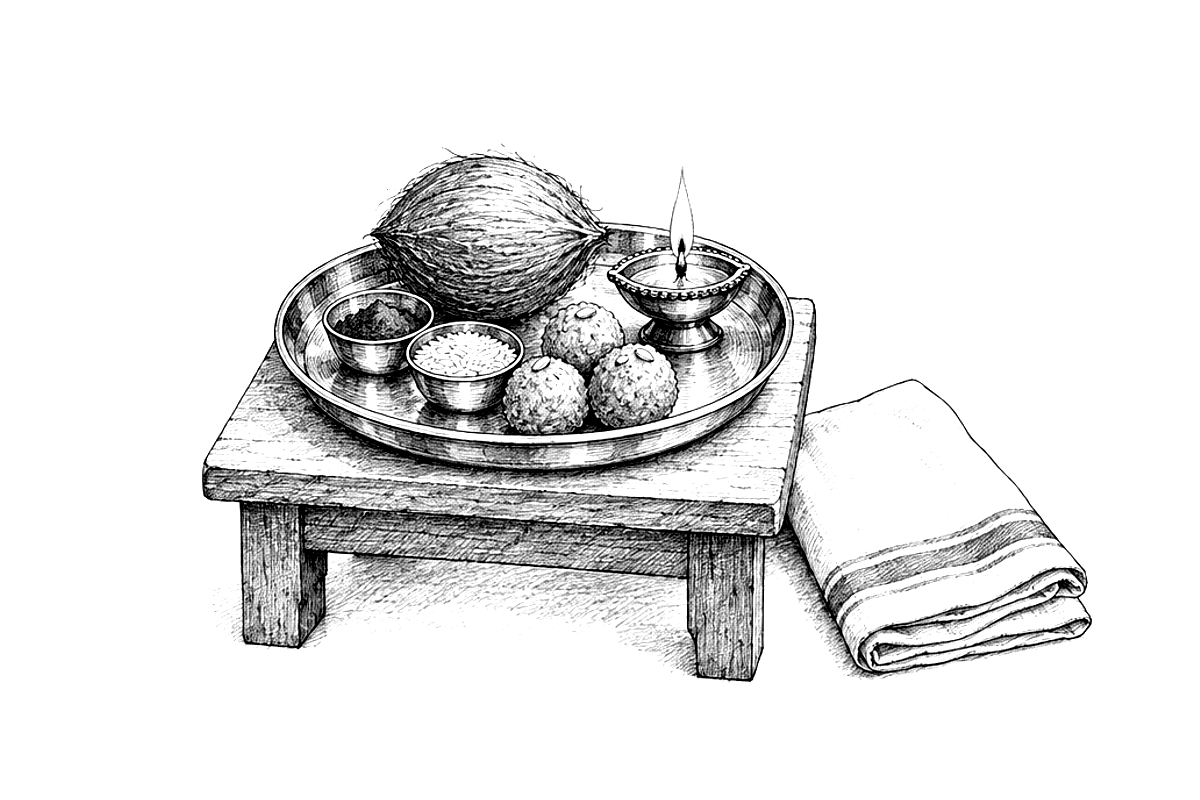
- 3Prepare the thali: roli or kumkum, akshat, a ghee diya, a coconut or dry coconut (gola), sweets, a flower, a little water and a sacred thread (kalawa) if it is your custom.
- 4Before the rite, the sister prays to Yama, Yamuna and the family deity, lighting the diya and offering a flower, for her brother's long life.
- 5The brother sits facing north or east. The sister sprinkles a few drops of water on him and applies a tilak of roli on his forehead, pressing a few grains of akshat onto it. In Bengal she applies sandalwood paste with her little finger while reciting the Bhai Phota rhyme.
- 6If it is your custom, she ties a kalawa on his right wrist and places a coconut, betel leaf and supari in his hands.
- 7She performs the aarti, circling the lit diya before him, and offers him a sweet to eat.
- 8The brother touches his elder sister's feet (or blesses a younger one) and gives her a gift, money or clothes as a token of love and a promise of protection.
- 9The sister serves her brother a festive meal cooked by her own hands; the katha says that food eaten at a sister's home on this day brings long life.
- 10Many families read or tell the story of Yama and Yamuna together. In Mathura, brothers and sisters bathe together in the Yamuna at Vishram Ghat on this day.
- 11In the evening, light a lamp facing south at the door as a prayer to Yama for the protection of all brothers and sisters in the family.
The tilak, aarti and meal are the sister's prayer for her brother's long life and well-being, blessed by Yama's own boon to Yamuna, and the brother's gift renews his promise to stand by her. The rite closes Diwali by drawing the wider family together.
Puja samagri
- Rice flour or rangoli powder for the square
- Low seat (pat or asana)
- Thali (plate) for the rite
- Roli or kumkum, and sandalwood paste in Bengal
- Akshat (unbroken rice)
- Ghee diya and cotton wick
- Coconut or dry coconut (gola)
- Kalawa (sacred red thread), where customary
- Betel leaf and supari
- Flowers
- Sweets
- Festive meal cooked by the sister
- Gift from the brother